
Only 8% of Young People Aged 18 to 30 Have a Wallet in Tunisia! And 41% Have an Account! The Alarming Figures from the UNDP Study Report of 09/22/2026
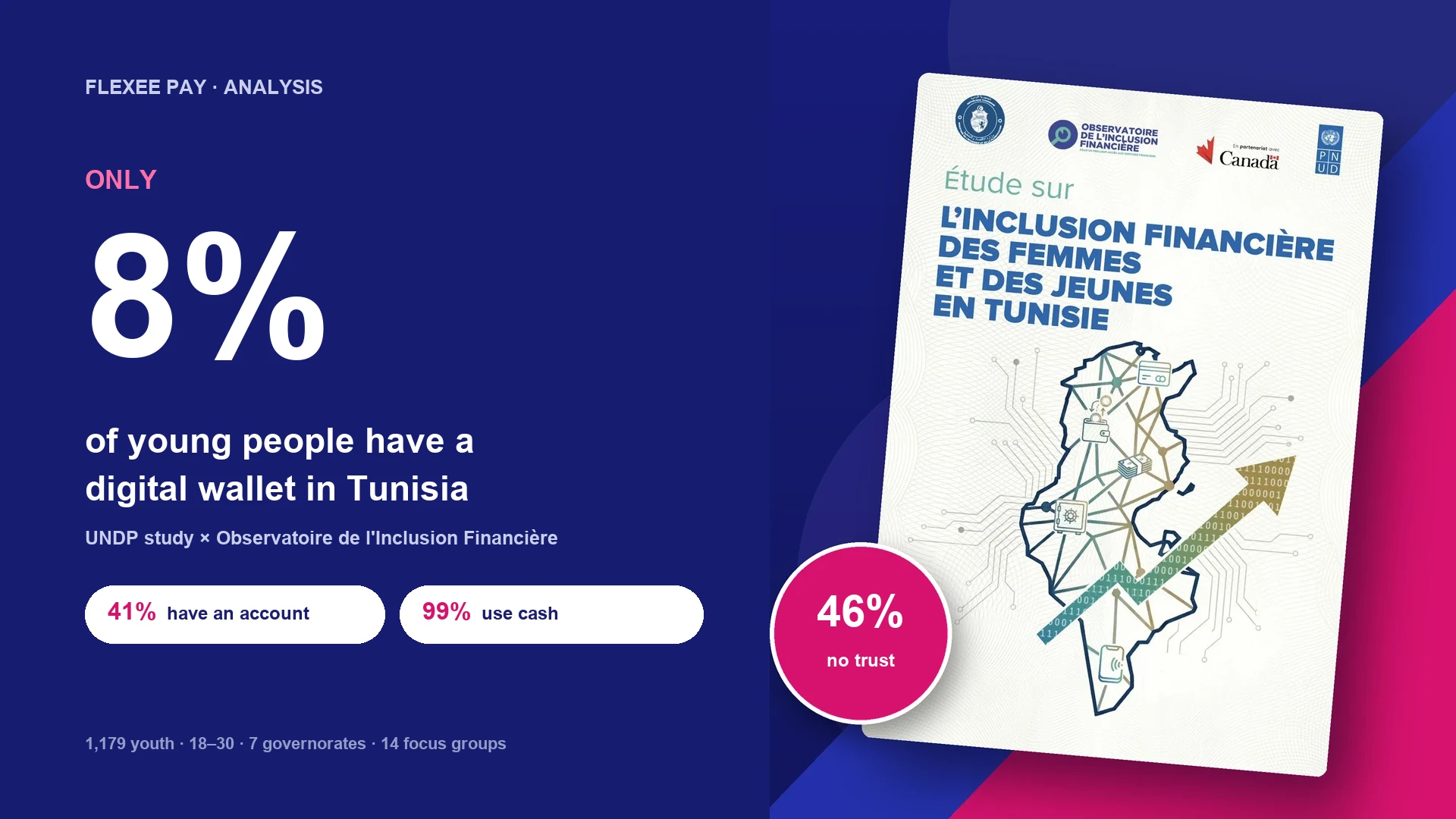
Only 8% of young Tunisians aged 18 to 30 have a digital wallet. 41% have an account with a financial institution - mainly at La Poste, and most often just to receive a scholarship, not by personal choice. These are the alarming figures from a study presented on September 22, 2026. These aren't rough estimates: they're the figures from a field study conducted in 2025 by the Observatoire de l'Inclusion Financière and UNDP, with support from Canada, among 1,179 young people aged 18 to 30 across 7 Tunisian governorates. The finding is unambiguous: an entire generation is growing up alongside the formal financial system - not by choice, but because it hasn't found its place there, and for lack of tools actually designed for it, like an account or a wallet genuinely suited to everyday life. The question is no longer whether to act. It's who will do it, and when. Our answer: now.
1️⃣ A field study, not just another survey
The "Study on the Financial Inclusion of Women and Youth in Tunisia" was carried out by the Observatoire de l'Inclusion Financière as part of the Green Economy & Women's Economic Empowerment in Tunisia project, implemented by the United Nations Development Programme with support from Canada, in partnership with the Tunisian Ministry of Economy and Planning. This isn't an online poll: it's field work carried out across 7 governorates (Kairouan, Gafsa, Tozeur, Kébili, Tataouine, Médenine and Gabès), combining a quantitative survey of 1,179 young people aged 18 to 30 and 1,457 women, with 14 focus groups to understand the "why" behind the numbers.
"Financial inclusion for women and youth is grassroots work that contributes to sustainable economic and social development," writes Raja Dahman, Director General of the Observatoire de l'Inclusion Financière, in the study's foreword. For Céline Moyroud, UNDP Resident Representative in Tunisia, the results "show that making progress on financial inclusion means bringing services closer to people, adapting products to economic and social realities, and rebuilding trust through dialogue and financial literacy."
"It's not just about opening accounts. It's about rebuilding young people's trust in a system they see as distant, complex, and not built for them."
The study moved from quiet reports to the airwaves: on September 22, Nadia Gouta presented its results on Express FM.
2️⃣ The numbers: what young Tunisians actually hold (and don't use)
The study's first finding: youth financial inclusion is limited, and above all passive. An account, when it exists, is rarely a choice - it's usually an administrative requirement (a scholarship, university fees) rather than a tool people actually make their own.
"Youth financial inclusion is limited: 41% hold an account with a formal institution, mainly at La Poste (27%), often due to an administrative requirement (a scholarship or university fees) rather than personal choice; use of other services remains marginal, with only 8% holding a wallet, 17% insurance (non-mandatory), and 92% having never taken out formal credit - reflecting passive, functional adoption of services, without real autonomy."
The rest of the financial usage picture is just as telling: 99% of young people use cash every day, seen as simpler, more immediate and free of charge. On the digital side, between 66 and 74% already check their balance online depending on the institution - proof that digital ease is there - but usage doesn't go further, held back by fear of errors, fraud, and a lack of merchants accepting wallet payments.
3️⃣ Why it's stuck: 3 recurring barriers
The study cross-references the quantitative survey with focus groups to identify three families of barriers, consistent from one governorate to another:
Socio-economic
- 23% of young people are unemployed, and 90% of employed youth report a monthly income below 1,500 TND.
- The account is often opened due to an administrative requirement (scholarship payments), without active or voluntary use.
- 70% of unbanked young people explain their situation by a lack of financial autonomy.
Socio-cultural
- 99% use cash, seen as simpler, immediate and free.
- Financial decisions remain influenced by parents, especially among students and inactive youth.
- Some sum it up: "the bank is for the rich" - a symbolic barrier as much as a practical one.
Psychological
- 46% don't trust digital services to manage their money.
- 75% have never applied for credit, out of fear of debt or personal conviction.
- 58% see insurance as too technical, complex or not very useful.
4️⃣ 5 faces, 5 relationships with money
Beyond the averages, the study maps out 5 typical youth profiles when it comes to money - useful for understanding that there isn't just one "youth" to win over, but several very different paths:
The dependent student
Still financially tied to their family; often lets their parents manage their account or choose their institution.
The inactive one
Unemployed and with no established relationship with financial services; a double exclusion, both economic and financial.
The day laborer
Informal income, paid day to day; cash remains by far the tool best suited to their daily life.
The aspiring independent
Early career, seeking independence; the profile closest to actively adopting financial services.
The digital skeptic
Freelance, connected, comfortable with technology - but cautious, even distrustful, when it comes to their money.
5️⃣ What they actually want
Perhaps the study's most encouraging point: young people don't reject financial services - they reject financial services that aren't designed for them. When asked what would change their mind, the answers are concrete.
Source: Observatoire de l'Inclusion Financière & UNDP, Study on the Financial Inclusion of Women and Youth in Tunisia (2025).
- Savings, as a priority: for young people not yet included, it's the top need expressed - handling unexpected expenses, funding a hobby, starting a small project.
- 45% say they're interested in microcredit dedicated to training, healthcare or job placement: a clear demand, as long as it stays simple and accessible.
- Digital, yes, but with conditions: openness to wallets and mobile savings exists, provided there's simplicity and perceived security - two non-negotiable requirements for this generation.
- Concrete incentives work: free transfers, sign-up bonuses… young people respond to whatever makes the first step tangible and risk-free.
- 14% have already benefited from non-financial services (training, support), mostly via training centers or local associations - and want more.
On communication, the study's message is clear: young people want an authentic voice, carried by young people like them, on the platforms they already use (Instagram, TikTok), in short formats (videos, stories), with simple language grounded in their reality - not a top-down institutional message.
6️⃣ What this means for us - and why it's time to start now
This study doesn't say young Tunisians are uninterested in money - it says the opposite. They want security, simplicity, autonomy. What they're missing isn't motivation: it's an offer designed for their age, their budget and their habits, with support that doesn't treat them like children, and education that replaces distrust with understanding.
This is exactly the gap Flexee Pay was built to fill: a platform designed from day one for young Tunisians (12-25) and their parents, combining an account, pocket money, expense tracking and financial education - without waiting until they're 25, have a fixed salary, and a good administrative reason to care.
Every month that goes by without action is another cohort of young people settling into the habit of cash, dependence on parents, and distrust of institutions - habits that, once set, are far harder to change at 25 than at 15. The UNDP study only confirms, with numbers to back it up, what the field shows us every day: the time to act isn't in five years. It's now.
Sources: Study on the Financial Inclusion of Women and Youth in Tunisia - UNDP / Observatoire de l'Inclusion Financière (2025) · Remarks by Nadia Gouta (LinkedIn) on Express FM, September 22, 2026.
